
This post is about tuning the KSGER T12 controller for use with the SS-331 desoldering gun. It is reasonably accurate, but if you follow it, you do so at your own risk.
Problem
So-called “affordable” desoldering guns are often good enough. The SS-331 may be “rather cheap” or “rather expensive,” but ultimately you want a compact unit with a normal handle for desoldering, ideally with a decent controller. Options like that are expensive.
SS-331H handle
As of now, you can buy the SS-331H handle separately. There is not much information about it at first glance, so here is the pinout:
- 1 - black - thermistor ground
- 2 - blue - thermistor signal
- 3 - red - heater ground
- 4 - red - heater VCC (24 V)
- 5, 6 - pump button pins
- 7 - yellow - reed switch
- green (to the case of the GX connector) - earth ground
The thermistor is about 47 ohms (around 47.8 ohms). Values may vary, so measure it yourself. The heater resistance is about 2 ohms and increases (AFAIR up to 3.5 ohms) as it heats. What does this mean? At 24 V, you will need a power supply that tolerates 12 A spikes. Or do what I did: use a 12 V power supply that can provide 8 A and stop worrying about burning outlets. Be aware that at startup you may see a spike of ~6 A, which quickly drops to 3-4 A after initial heating. This spike can be enough to kill a weak supply. In short, take this one and forget about these problems.
Short note about thermocouple vs thermistor
Like me, you may not be familiar with all these “what’s the difference” notes. A thermocouple generates a small voltage (a few millivolts) by itself, without any power supply. A thermistor generates nothing; it just changes resistance. Its readings are also usually rougher. This means that any circuit designed for a thermocouple will not work with a thermistor, simply because a thermocouple input expects a generated voltage while a thermistor provides none. To mimic a thermocouple’s behavior with a thermistor, you should do the following:
- Measure its resistance at 25 degrees Celsius.
- Supply some voltage to the circuit (via an add-on).
- Subtract from this voltage the value corresponding to the thermistor’s initial state.
- Scale appropriately to mimic the thermocouple’s target voltage.
Sounds complex, but in fact a single op-amp is enough.
KSGER 2.1s module
Many people talk about different layouts, but currently you will find only one official one. It does not have any zero-ohm resistor or a dedicated place to support JBL. So you need to make the following changes:
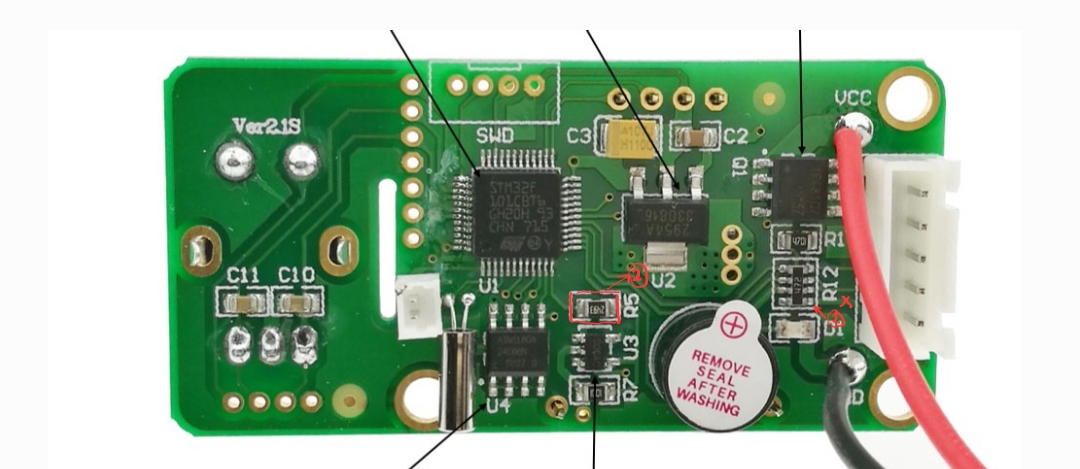
- Cut the trace at point one (lowest part of the resistor combo). This disconnects the thermocouple sensor from 24 V+.
- Remove the R5 resistor. It is responsible for amplifying the signal, and you will need to add a headcrab board at this spot to mimic a thermocouple with a thermistor.
From thermistor to thermocouple
You need the following headcrab schematic:

How it works (simplified):
- You have two potentiometers that let you tune (a) the signal from the thermistor and (b) the signal from the 47-ohm reference resistor. The latter is used to subtract the thermistor’s initial resistance so the scale starts at zero.
- The op‑amp subtracts the signal from the 47‑ohm resistor from the thermistor signal.
- The op‑amp output is fed to U3 through point 1 on R12.
- Use the potentiometer on the left to tune the final amplification at U3.
- Use the 3.3 V rail from the display, for example.
Yes, of course, you can probably do this circuit much better. But I am lazy, and this way I could tune everything easily.
Headcrab calibration procedure
Some tips:
- Without a dedicated thermometer, you will burn something. Take one like this before you start.
- Without a current-limited supply, you will most likely burn something again. Get one before you start.
- Get used to quickly putting the KSGER controller into sleep/standby. Do it fast.
- Or better: make a resistor divider from 47 ohms (0 C) to 150-156 ohms (around 400-420 C for the gun heater). First calibrate only the thermistor reading with the heater disconnected. Yes, it works this way.
- The
INVERTmessage tells you that there is negative voltage on the U3 input. Do not panic, but if you see it, check voltages everywhere. - Note that the resistance of the gun heater goes from 1.6 ohms in a cold state (room temperature) to around 3.5-4 ohms at 420 C. That means even if your 24 V supply works fine after you have already heated the gun to, say, 300 C, it may still burn your controller when starting from cold due to a ~12 A spike.
- Note that the temperature of the gun nozzle is different on its enclosure and at the tip. Measure at the tip. Always.
The procedure (with a resistor divider that mimics our thermistor):
- Assemble headcrab and controller.
- Set your current-limited power supply to 12 V.
- Connect a 47-ohm resistor to T+ and T-.
- Set both potentiometers to some initial value (for example, maximum).
- First, achieve a value close to zero at POINT 1 at room temperature. For that, you should have equal values on T+ and on the headcrab R5 output going into the op-amp. Do not make these values less than 1 mV (too small). Do not try to achieve absolute zero at POINT 1 - set something like 0.3 mV. AFAIR I had ~5-6 mV on both. You may do better.
- Check that you have no
INVERTmessage: turn it all off, then on again. If you still haveINVERT, repeat step 5. - Check the displayed temperature. Tune RP3 to around 25–35 C.
- Turn the controller off.
- Connect a 150-156 ohm resistor to T+ and T-.
- Tune RP3 to around 400–420 C.
- Re‑check with 47 ohm. If you get the same values as before, you’re fine. If not, find golden values — an initial value around 30–35 C and a maximum around 400 C.
- Turn the controller off.
- Connect thermistor pins 1 and 2 to T+ and T-, respectively.
- Connect pin 3 to ground on your GX aviation connector and pin 4 to 12 V on the same connector.
- Put your hand on the controller knob and be ready to immediately put it into sleep by quickly turning it left.
- Power everything on and put it into sleep state. If initial values are fine, continue. If not, find out why. Tip: if you have a floating ground like me, something like 100 ohms from POINT 1 to ground can help (though recalibration from the beginning will probably be needed).
- Set the target temperature to 150 C and start heating. Measure the temperature with your thermometer. If something goes wrong, stop, turn off, and rethink. Adjust RP3 along the way (very carefully). If all is OK, repeat for 300 C and 400 C (probably up to 350 C, since to achieve 400–420 you need something like 14 V on your power supply). Anyway, 350 C is totally fine.
- Put controller to sleep state, wait and see how the temperature goes down. The initial reading should be the same.
- Allow the gun to become cold and recalibrate if needed.
- Test, test, test - and be ready to turn everything off quickly at any step. Have I said this? Yes: please be ready for that. Also make sure your power supply is either current-limited or can handle up to 12 V / 6 A.
Pump
I took this one, but you may find another. I connected it using a typical “MOSFET module with optocoupler” to save time (this one). Nobody seems to know how to trigger the controller so it detects the pump (even though it has a dedicated menu), but you do not need that since the SS-331 gun has its own pump button. Put it in series with the 3 V signal and you are done.
Connector
AFAIK, a 7-pin GX connector is enough if you do not want to add ambient temperature sensing. Otherwise, you will have to change the default cable and re-crimp (yes, re-crimp, not resolder) it with the heater, and so on. I suggest not dealing with it - just skip ambient temperature. The tilt switch is already inside, though it works so-so. But AFAIK sleep mode turns on fine, so it works at least somehow.
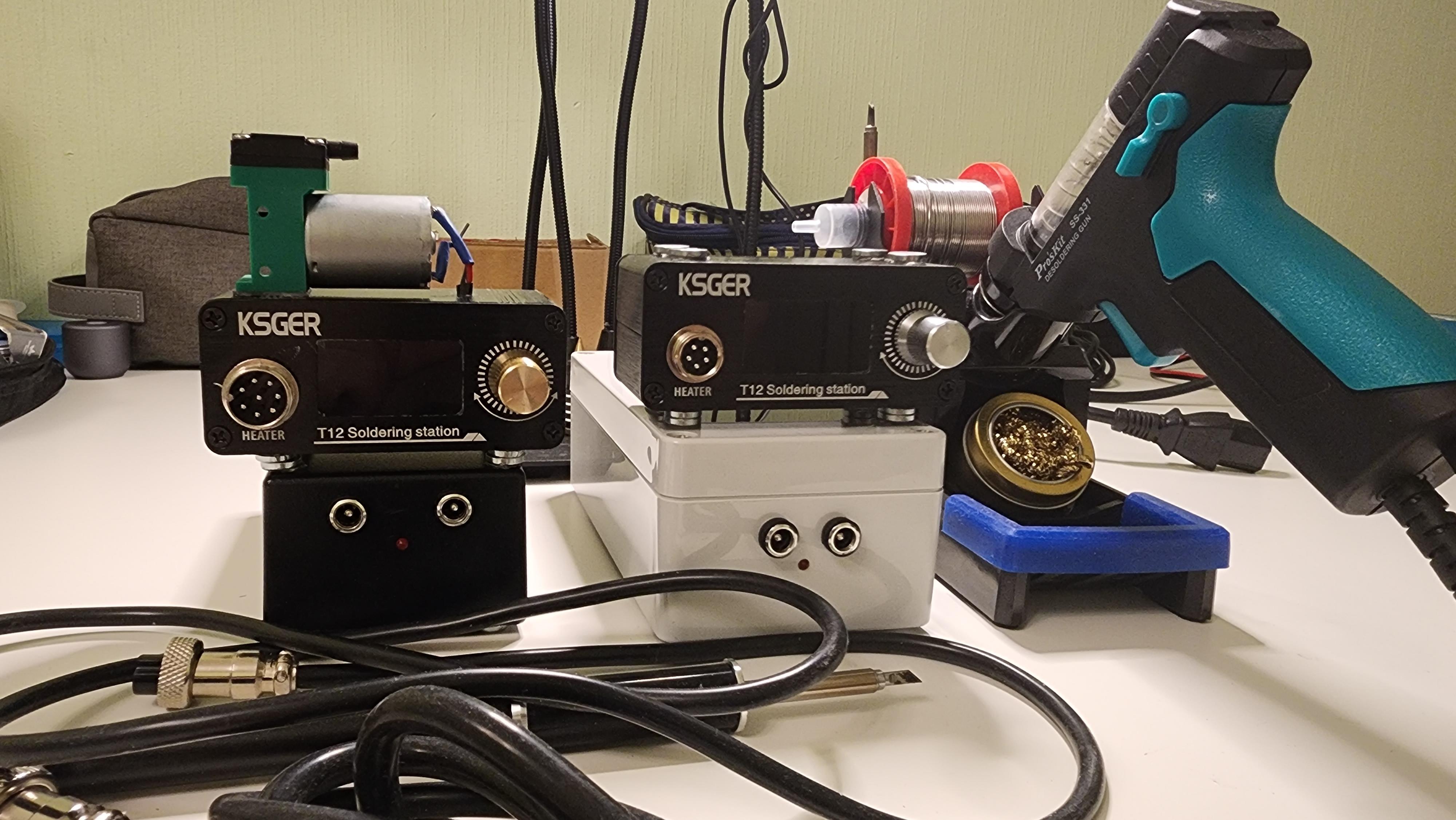
How does it look
Like this - and yes, it works fine:
Bonus
Temperature-resistance table:
| Temp | Ohms |
|---|---|
| 450 | 168 |
| 430 | 156 |
| 400 | 150 |
| 380 | 138 |
| 370 | 134 |
| 360 | 133 |
| 350 | 131 |
| 340 | 129 |
| 300 | 123 |
| 240 | 90 |
| 220 | 86 |
| 200 | 83 |
| 180 | 79 |
| 160 | 73 |
| 160 | 74 |
| 150 | 72 |
| 140 | 70 |
| 130 | 68 |
| 119 | 66 |
| 100 | 63 |
| 80 | 59 |
| 70 | 57 |
| 50 | 53 |